The re-constructed Globe theatre on Bankside is just short walk from where traces of William Shakespeare’s original theatre were unearthed in 1989. Plays are today performed in an open-air venue that would have looked familiar to theatre-goes in the late 16th and early 17th centuries when this was the main theatre district.
“Daily at two in the afternoon, London has sometimes three plays running in different places, competing with each other, and those which play best obtain most spectators”, commented a Swiss traveller in 1599.
But as I wrote in last week’s post, bringing so many people into a district for an often-rowdy day out help contribute to Bankside’s notorious reputation.

The original Globe on Bankside
The origins of the Globe – the third playhouse to be built on Bankside after the Rose and the Swan – can be traced back to the Theatre in Shoreditch, on the north side of the Thames. After James Burbage, the Theatre’s founder, died in 1597 the landlord in Shoreditch, Giles Allen, refused to renew the lease.
And so Burbage’s sons, Richard and Cuthbert, decided to take down the Theatre timber by timber during the night to avoid detection, and rebuild it on Bankside. With the help of the theatre’s troupe of actors, the Lord Chamberlain’s Men (later known as the King’s Men after receiving Royal patronage from James I in 1603), and an army of volunteers, the timbers were then loaded onto barges and transported across the Thames. The new venue was named the Globe after the figure of Hercules carrying a globe on his back which had parallels with Burbage’s men moving the Theatre’s timbers to Bankside.
William Shakespeare was one of the members of the Lord Chamberlain’s Men, the company’s playwright and he was a shareholder in the new Bankside venture. He moved from Bishopsgate to live in the area near the Globe sometime after 1596. It’s likely he worshipped at St Saviour’s, now Southwark Cathedral, where his brother’s funeral was held, and he probably visited a number of the inns in the district.
The Globe was where the first performances of Shakespeare’s plays including Hamlet, King Lear Macbeth and Othello were shown. In Henry V the actual ‘Woodden O’ theatre is mentioned in the prologue by the playwright. “Can this Cock-Pit hold The vastie fields of France? Or may we cramme Within this wooden O, the very Caskes That did affright the Ayre at Agincourt?” Ben Jonson, a fellow playwright, described the Globe as the “glory of the Bank.”
Watching a play
Swiss travel Thomas Platter in 1599 visited the newly opened Globe theatre which could accommodate some 3000 people, to see an “excellent performance of the tragedy of the first Emperor Julius Caesar, with a cast of some fifteen people.” He reported that the actors were “most expensively costumed.” But there weren’t originally any elaborate sets – the focus was very much on the audio and Shakespeare included lines in his plays to describe where the action was taking place to help guide the audience.
Platter applauded the construction of the playhouses with acting taking place “on a raised platform, so that everyone has a good view.” Admission fees for performances, which usually began at 2pm, varied depending on where people sat or stood. “For whoever cares to stand below only pays one English penny, but if he wishes to sit he enters by another door, and pays another penny.” Sitting in “the most comfortable seats which are cushioned, where he not only sees everything well, but can also be seen, then he pays yet another English penny at another door.”
Platter reported that “during the performance food and drink are carried round the audience, so that for what one cares to pay one may have refreshment.” Beer, apples, hazelnuts and tobacco were among the items known to be sold to theatre-goers at Bankside’s playhouses.
Going to the theatre in Elizabethan times was a noisy affair with the audience heckling performers (or even throwing food at them!) if they felt the performance was boring. Some playgoers might also have been more interested in playing a game of cards while the actors performed.
Disaster and closure
Special effects were often used during performances at the Globe. Pebbles were rolled in a drum to simulate waves, for example. But disaster struck at the Globe in 1613 when a theatrical canon misfired during a performance of All is True about the reign of Henry VIII, igniting the wooden beams and thatching.
Sir Henry Wotton, a diplomat and poet, provided an eye-witness account in a 1613 letter, describing how the fire “ran round like a train, consuming within less than an hour the whole house to the very ground.” He added that “one man had his breeches set on fire” but “by the benefit of a provident wit, put it out with a bottle of ale.”
While the theatre was completely destroyed, remarkably it seems no one died in the blaze and props, costumes and books belonging to the King’s Men were all salvaged. The Globe was rebuilt within a year at a cost of about £1400 with a tiled roof – as opposed to a thatched one. John Chamberlain commented a few days after its opening: “I hear much speech of this new playhouse, which is said to be the fairest that ever was in England.” Not long after that, in 1616, Shakespeare died in Stratford-Upon-Avon.
The Globe was closed down by the Puritans in 1642 and two years later orders were given for it to be demolished. Landowner Sir Matthew Brend subsequently built tenement houses on the site. The History and Antiquities of St Saviour’s, stated in 1795 that “the passage which led to the Globe Tavern, of which the playhouse formed a part, was, till within these years, known by the name of Globe Alley, and upon its site now stands a large storehouse for porter.”
After the monarchy was restored under Charles II in 1660 the Bankside playhouses didn’t return. New theatres were instead established across the Thames in Drury Lane and Dorset Gardens and were, according to Samuel Pepys “a thousand times better and more glorious than ever before.” Inside these new buildings, he added that “now all things civil, no rudeness anyway.”
Re-building the Globe
In 1949 an American actor called Sam Wanamaker arrived in London and was amazed to discover that the Globe was remembered by little more than a grubby bronze plaque on the wall of the Anchor Brewery (it can today be seen in Park Street, close to where part of the original Globe was found). Fast-forward to 1970 and he established the Globe Playhouse Trust (later known as the Shakespeare Globe Trust) with a goal of re-building Shakespeare’s theatre.
Wanamaker soon encountered opposition to his plans. The deputy leader of Southwark Council described Shakespeare as “tosh”, while it was claimed the proposed riverside plot was needed as a storage yard for the local authority’s street sweepers or for housing for those on low-incomes.
Nevertheless, Wanamaker ploughed on, supported by a South African-born designer and architect called Theo Crosby, and the case reached the High Court where they won against Southwark Council. Construction of the third version of the Globe theatre began in 1993. Helped by archaeological discoveries, visitors accounts and contracts from neighbouring theatres, the team used authentic materials, including green oak timber, lime plaster and thatch for the roofing – the first time the latter had been used in London since the Great Fire of 1666. This meant adding a sophisticated sprinkler system which is capable quickly of drenching the building in the event of a fire.
In 1997 the Globe was formally opened by Queen Elizabeth II. But sadly Wanamaker didn’t get to see this momentous occasion – he had died in 1993 at the age of 74 and is remembered by a memorial tablet next to the Shakespeare Window in Southwark Cathedral. Theo Crosby, the project’s architect, passed away in 1994.
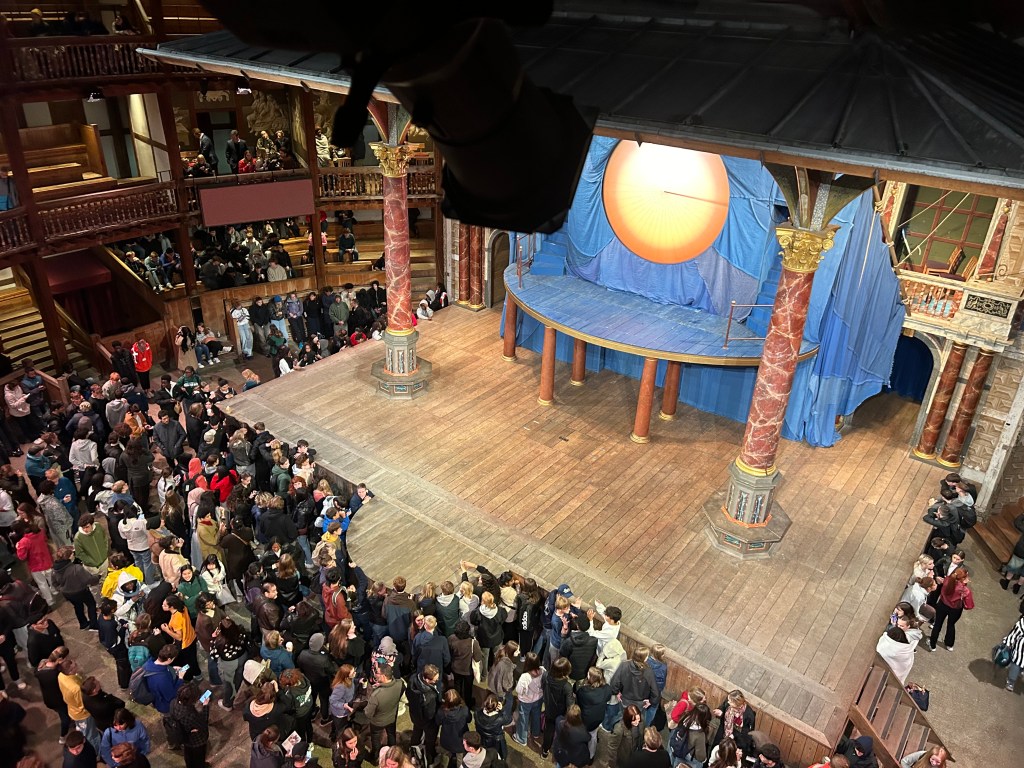
The Globe also opened a 340-seat indoor performance space called the Sam Wanamaker Playhouse alongside its outdoor venue in January 2014. Lit by candles, it was based on drawings thought to be have been produced by Philip Webb around 1660 of a venue similar to the Blackfriars one which was demolished in 1655. For many years, the same company used the Blackfriars venue during the winter months (and it was relied upon until the Globe was back up and running following the fire in 1613).
While up to 3000 people watched plays at the Globe in Shakespeare’s day, the replica is only licensed for around 1600 people given modern-day safety regulations. There were originally just two exits, now there are seven. Today, there is the option to stand in the exposed groundling area in front of the stage (tickets here are £5 or £10, as opposed to one penny in the 16th century). As in Shakespeare’s day, it costs more to have a seat in one of the covered galleries (I paid £72 to watch a recent production). But these benches still aren’t the most comfortable, even with cushions (£3 rental). The stage is covered by a roof, ornately painted underneath with depictions of the Heavens, and held up by two large pillars.
If you do a tour of the Globe theatre, your ticket includes entry to their exhibition which provides some background on the original theatre and building of the current one. However, my favourite exhibit is on display near the gift shop: a 1623 printed copy of what has become known as the ‘First Folio’ which reproduced 18 of Shakespeare’s plays. And every time I pass the Globe, I’m wowed by the wrought-iron gates providing an entrance from the riverside and featuring motifs from 130 different blacksmiths from 12 countries. The 125 designs depict the animals, creatures and plants that were include in Shakespeare’s plays.
At the nearby site of the Globe’s original location off Park Street, coloured cobblestones in the courtyard of Old Theatre Court show where a small part of Shakespeare’s playhouse was found in 1989. Given that numerous buildings had stood on the site since the Globe was demolished in 1644, the archaeological remains have been severely damaged. Those that were found are now buried two metres below the current ground surface. More of the Globe may remain buried under Anchor Terrace, a late Georgian residential development.

 Wrong Side of the River: Borough and Bankside's disreputable past
Leave a comment