
In the basement of a former warehouse near Borough Market, lies a small museum charting the gruesome history of one the country’s oldest and most notorious prisons. Entering the dimly lit Clink Prison Museum, located below a branch of steak restaurant Flat Iron, you are greeted by a sign claiming this was “the prison that gave its name to all others.”
What’s remarkable about this place is that it was established as private cells for the Bishop of Winchester to lock-up those who had committed crimes in the disreputable district he controlled outside the limits of the City authorities. The institution existed for some 600 years and is said to provide the origins for the phrase “to be thrown in the Clink” – referring to the clanking of chains around prisoners’ feet.
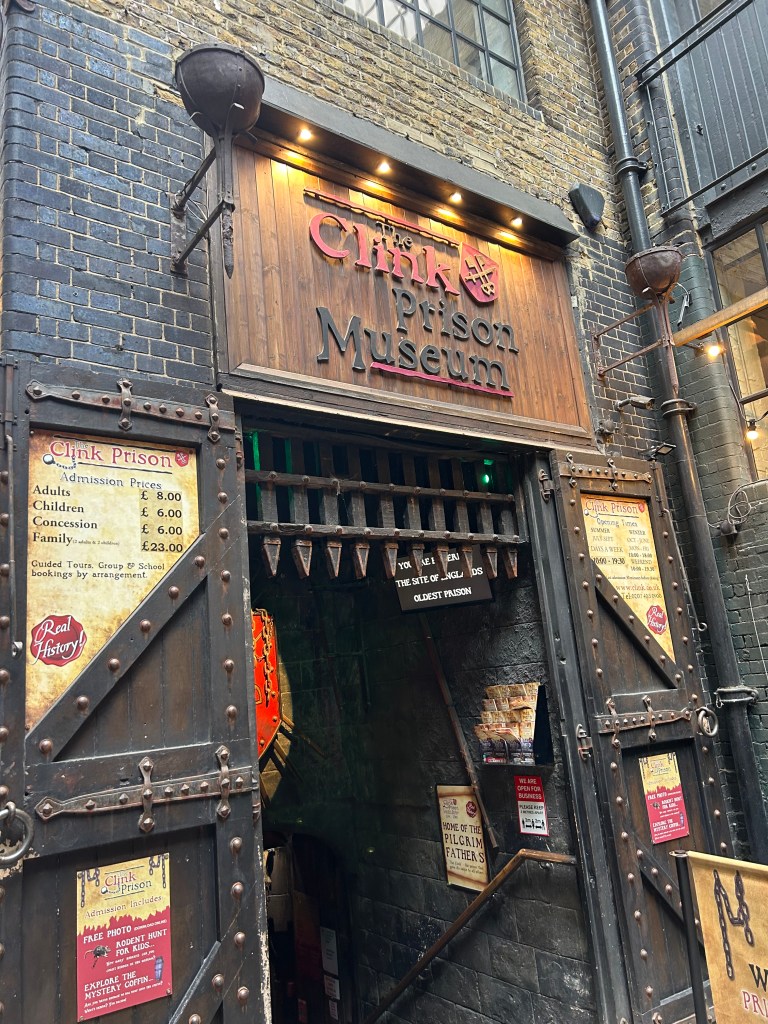
Bishop’s prison
The first mention of ‘the Clink’ in name seems to have been in 1509, but it’s believed there was a prison here from as early as the 12th century (the museum cites a very precise date of 1144) when Bishop of Winchester established private cells in the grounds of his palace. As I wrote in last week’s post, this senior member of the clergy was overlord of much of Borough and Bankside for some five centuries.
Outside the City walls, north Southwark gained a reputation as a disreputable district. Those arrested for taking part in drunken brawls, running up debts or sex workers and brothel owners, who failed to obtain proper ‘licenses’ from the bishop could find themselves detained in the Clink. Religious prisoners were also later held here. The Clink was one of five prisons in Southwark (the other four were located on the High Street) which historian John Stow said in the late 16th century was “for such as should break the peace on the said bank, or in the brothel-houses.”
Rather than directly operating the prison himself, the Bishops of Winchester charged fees to franchisees who would in turn levy payments from inmates. Prisoners at the Clink would have been billed for items such as bedding food and drink. If inmates wanted better treatment, such as having their chains removed, they would need to pay for the privilege. And guards also took it upon themselves to extort additional money through exerting violence.
As the Clink was housed underground, prisoners would be exposed to raw sewage when it flooded, with John Stow writing that it was “at best uncomfortably damp.” Inmates may have tried to attract the attention of passers-by through the gratings in the wall, perhaps earning them some food or other hand-outs.
Rebellions and religious prisoners
The Clink was caught up in many significant events of England’s history. During the Peasant’s Revolt in 1381 – when the poor stood up to wealthy landlords to demand better conditions – Wat Tyler’s men set off from Kent and on their way into London freed prisoners from their cells at the Clink. The following century, in 1450, the prison was attacked in 1450 during the rebellion of Jack Cade and his followers. Prisoners were again set free from the Clink and it needed to be re-built. That re-construction saw the building of a new two-storey prison for men on the current site of the Clink Prison Museum.
In the 16th century a number of people who opposed the church were held here. Under Bloody Mary’s reign these included Protestants such John Rogers – who was locked up for translating the Bible into English from Latin – and John Hooper, the Bishop of Gloucester. After being found guilty of heresy they were both sentenced to death.
When Elizabeth I took the throne, the Clink became a prison for detaining Catholics who were seen as traitors. These included the Jesuit priests William Weston and John Gerard, the former who was linked to Catholic plots to kill the Protestant queen and who later wrote about secretly holding mass at the Clink. Elizabeth I became wary of Protestants who were intent on breaking away from the Church of England, known as separatists, and they too were held here. They included John Greenwood and Henry Barrow who would be executed “to still their tongues”.
As I wrote in last week’s post, during the Civil Wars of the 1640s Winchester Palace was used to hold Royalists. But after the sale of the house and grounds in 1649, it is likely that the prison fell into disuse and in 1720 the historian John Strype described the prison as “of late years [and] of little or no account”. During the Gordon Riots of 1780 – when Protestants worried about parliament relaxing anti-Catholic laws – prisoners were set free and the Clink was burned down. This time it wasn’t re-built. Yet the remains of a wall of the former institution from 1680 to 1780 is preserved in the Clink Prison Museum.
Museum exhibition
Today, the Clink Prison Museum exhibition attempts to provide visitors with an overview of the history of the institution and chronicle daily life. In the background a soundtrack of recorded groans and wails is played. The displays set in a series of dark rooms include harrowing accounts of inmates’ experiences in the Clink. For example, we hear the sad case of Ellen Butler who believed she was applying for a job as a maid on Bankside but found she had actually arrived at a brothel. When she attempted to leave, her new employer, Thomas Boyd, faked evidence against her and she was sent to the Clink. The museum includes a waxwork depicting Ellen, but unfortunately it is not recorded what happened to her.
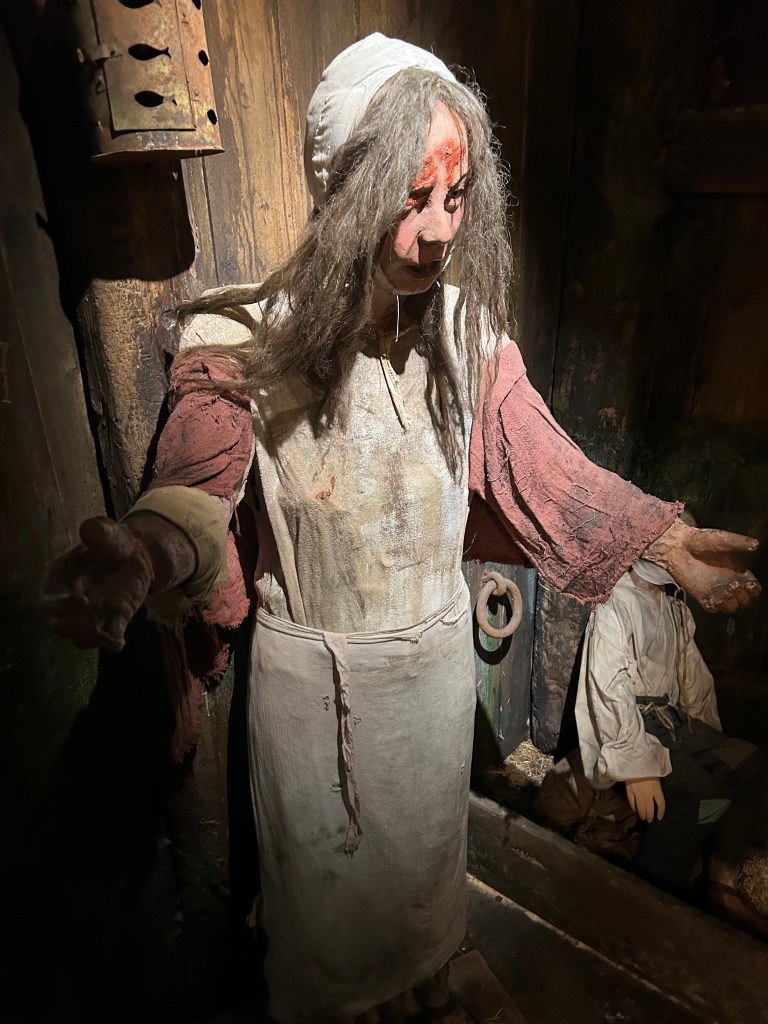
Space in the exhibition is also given over to describe how those deemed guilty of crimes were punished outside the prison walls. On display is an example of a pillory where victims were humiliated as the likes of manure and rotten vegetables were thrown at them. There is discussion about how people were executed through methods such as boiling and the gallows. Instruments used to torture prisoners are also displayed.
Charted on the panels in the museum are claims that I have not come across elsewhere. One being that “Henry VIII himself reportedly frequented Bankside, and was alleged to have been ‘bitten’.” This term, the display notes, was a polite way of describing those who returned “from Southwark with a sexually transmitted disease.” Where this story is meant to originated from is unclear because no source is given. Whatever the truth of these stories, it is still fascinating to be able to recall something of the history of the Clink on the very spot where the Bishop’s cells once existed.
 Wrong Side of the River: Borough and Bankside's disreputable past
Leave a comment