
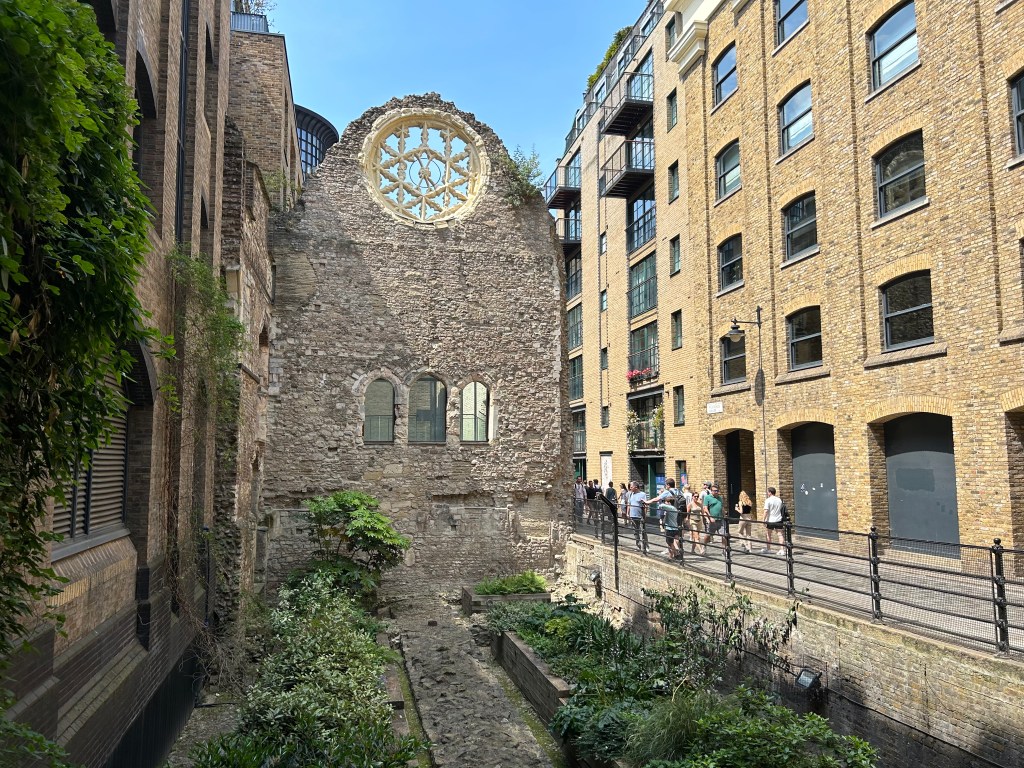
If you grab a seat on the upper floor of a branch of Caffe Nero in Bankside, close to where the Golden Hinde replica ship is moored, you will have a ringside view of the remains of the great hall of Winchester Palace. This formed part of the London residence of the Bishops of Winchester and was one of the most important buildings in the medieval capital.
The influential members of the clergy that lived here had an important role in shaping the surrounding area and the disreputable reputation it gained. They became extremely wealthy from a range of activities that took place on their estate – from licensing brothels to profiting from the Clink prison.
It’s the perfect place to start the journey that I will chronicle on this blog in explaining why this was the Wrong Side of the River.
Bishop of Winchester’s home
Winchester House was just one of the many manors and inns on Bankside to be owned by senior members of the clergy and wealthy families during medieval times. They acted as prestigious lodgings for out-of-town church leaders and other important figures while in London on church and state business. Edward II had a walled and moated residence, known as the Rosary, built for his use around modern-day Tooley Street, roughly between Hay’s Galleria and Tower Bridge.
The more modest inns could be found set back from the main thoroughfares of the High Street and Tooley Street with a hall, chapel, living accommodation and stables. Mansions like that of Winchester House, built by the Bishops of Winchester, were more expansive and set in spacious grounds.
Construction of Winchester House began on land granted by Bermondsey Abbey just to the west of St Mary Overie priory church (now Southwark Cathedral) in 1107 under William Giffard, the holder of the Bishop of Winchester post at the time. His successor, Henry of Blois (grandson of William the Conqueror and brother of King Stephen), vastly expanded what became known as Winchester Palace, with its grounds covering 70 acres and stretching along the riverfront, from just west of London Bridge to near where the Tate Modern is today. Others added to the property, including William of Wykeham in the 14th century who installed the splendid rose window in the great hall.
Winchester Palace was arranged around two courtyards and included a brewhouse, butchery, stables, a tennis court and bowling alley. There were also pleasure gardens, fishponds, vegetable patches and space for keeping livestock.

The Bishops of Winchester were highly influential in the affairs of the nation, holding the important role of Chancellor on no fewer than eight occasions between the 14th and mid-16th centuries. This helped Winchester Palace become a prominent landmark and it was visited by many dignitaries.
Thomas Becket, the Archbishop of Canterbury, stayed here in 1170 after preaching at St Mary Overie, the night before he was infamously murdered in his own cathedral by four Norman Knights who thought they were carrying out the wishes of King Henry II. James I of Scotland and Joan Beaufort held their wedding feast at Winchester Palace in 1424, and Elizabeth I visited for dinner in 1577. On one occasion it was reported the walls of the great hall were “festooned with sumptuous hangings of arras, shot with silk, silver and gold.”
In 1551, the then Bishop of Winchester, Stephen Gardener, ran into trouble for trying to block changes to religious doctrine and he was thrown into the Tower of London. As a result, Winchester Palace was granted to the Marquess of Northampton, but Gardener regained his home in 1553 when Mary I took the throne.
Overlord of the Clink
Winchester Palace was more than just the bishops’ home. From here the senior clergy performed their role as overlords of large swathe of modern-day Borough and Bankside. Outside the jurisdiction of the City authorities, the bishops enjoyed virtual autonomy over what became known as the Clink, one of five manors in Southwark. And they became extremely wealthy as they profited from licensing brothels and other illicit activities that were banned or restricted, across the Thames, in the walled City on the other side of the river.
Authorities in the City accused the Southwark manors of taking away their trade, and they became irritated that they provided shelter for criminals and debtors. Edward II proclaimed in 1326 that “malefactors after their offences flee to Southwark… out of the city, because the ministers of the city cannot attach [arrest] them there.” Claims were made that groups of hundreds of villains were rowing from the south side of the river to commit their crimes in Westminster and the City.
Over time the City managed to gain more influence over Southwark. In 1327 a royal charter gave the authorities on the north bank control over one of the five manors, the Guildable. And in 1550, another charter – granted by Edward VI – brought the manors of Guildable, Great Liberty and King’s together as a new City of London ward: the Bridge Without. But crucially the independence of two other manors of the Clink and Paris Garden, as well as an area called the Mint, survived and so the unruliness of Bankside continued for many years to come.
Palace in decline
John Stow described Winchester Palace in 1598 in the Survey of London as a “very fair house, well repaired, and hath a large wharf and landing-place called the bishop of Winchester’s stairs.” But in reality, the property was in already in decline by that point. The Bishop of Winchester, Richard Fox, wrote in 1528 to the Lord Treasurer that he needed to repair his “ruinous house in Southwark” – and therefore asked to be excused for non-payment of a debt. Then, in 1554, many goods and all the books in the house were destroyed by rebels under the leadership of Thomas Wyatt who attempted to overthrow Queen Mary I.
The last Bishop of Winchester to live at Winchester Palace was Lancelot Andrewes, who died in 1626. Said to have mastered 15 languages and whose sermons T.S. Eliot believed ranked “with the finest English prose of their time”, his splendid tomb can be seen in Southwark Cathedral today.
During the 1640s Civil War the house became a prison for detaining Royalists before it was bought by Thomas Walker of Camberwell for over £4000. The land at time of the sale included “wharfes and wharfage at St Mary Overie Dock… buildings, gardens and yards… and the kitchen Garden Wall of the said manor house and the tenement lands and garden and all the Cottages or tenements anciently called the Pond Garden alias Pikeyard and now commonly called the Clink Garden…. together with a gatehouse leading from Stewes Bank towards the Borough of Southwark.”
On the Restoration of the monarchy under Charles II, the Bishop of Winchester regained possession of the manor. But rather than choosing to use it as a home again, in 1662 he secured a private Act of Parliament “to lease out the tenements now built upon the site of his mansion house in… Southwark.” Over the years various industries operated from parts of the site, including glassmaking and the manufacturing of mustard.
In August 1814 a fire broke out which destroyed much of a factory building on the site, but this inadvertently helped reveal the great hall and its magnificent 14th century rose window – the outstanding feature of the ruins on display today. During the Second World War a warehouse that stood on the south-west corner of the old palace was completely gutted by incendiary bombs and restoration work began in the 1970s.
Today, the remains that can be seen in Clink Street include the gable wall with the rose window, and traces of doors which led to the buttery, pantry and kitchen. Below there was a vaulted wine cellar and a passage provided direct access to the Thames for deliveries via a neighbouring wharf.
Chaos continues
While the Bishop of Winchesters no longer lived in Winchester Palace after the 17th century, this was by no means the end of the area’s administrative chaos. It wasn’t until the Local Government Act of 1888 that the Clink and other liberties were fully abolished and they became part of a new county of London.
In the interim this meant a highly complex system of bodies administered – or at least attempted to administer – the Bishop of Winchester’s manor and that of Paris Garden. The historian Simon Jenkins described the likes of parish vestries which were nominally responsible for law, order, welfare and other services as “out of their depth” and there was “virtual anarchy”.
This very much sets the scene for what’s to come on this blog in the weeks and months ahead. Bankside and Brough remained a notorious district for many centuries. It is why the area, on the southern side of the Thames, became known as the Wrong Side of the River.

 Wrong Side of the River: Borough and Bankside's disreputable past
Leave a comment